 SONA Robotics
ROS 2 fundamentals
Topics, services, actions, parameters, launch files and package structure on a real robot.
ORBIROB FOR UNIVERSITIES
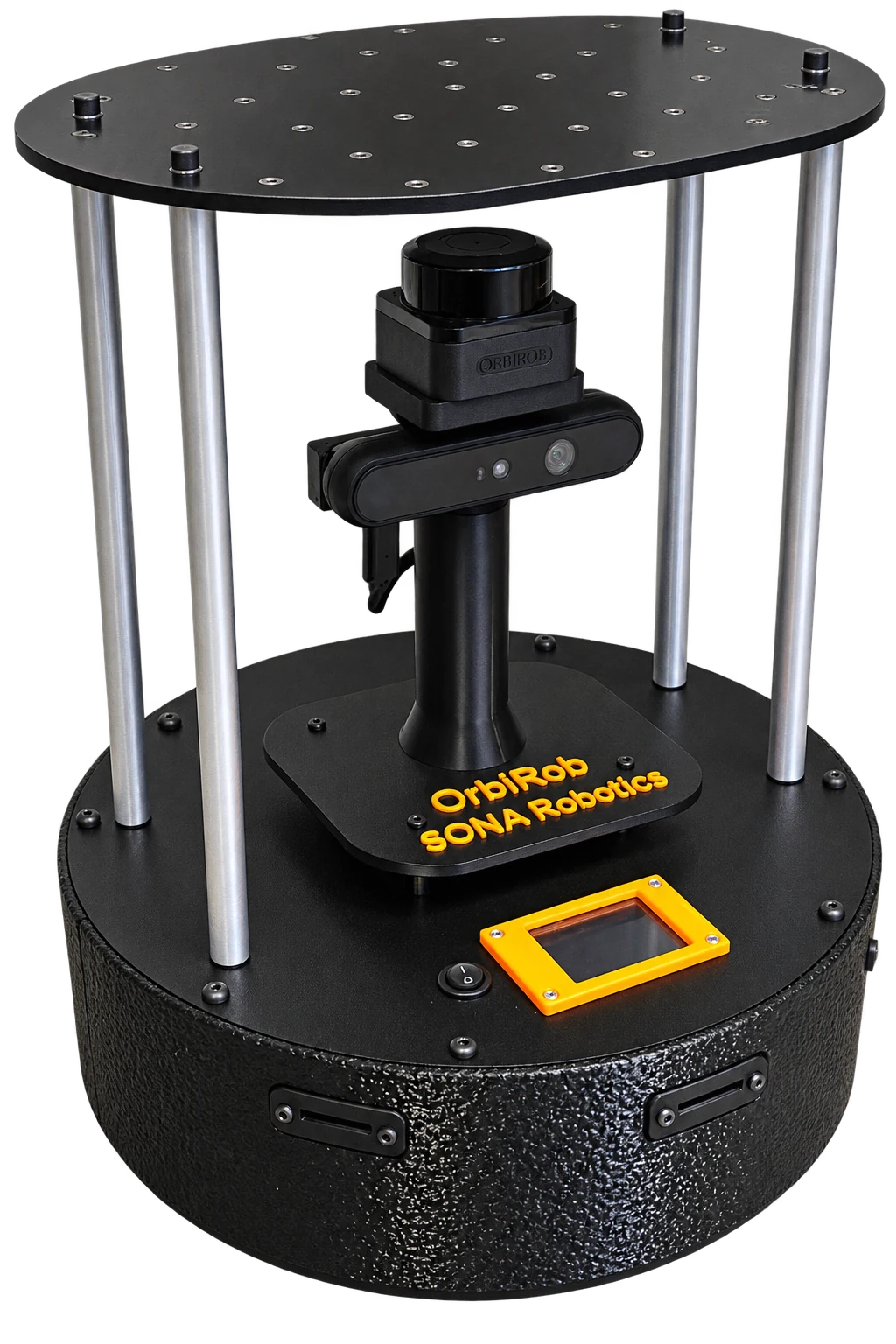
A complete teaching and research platform for courses that need more than simulation alone. Develop in Gazebo, move the same ROS 2 architecture onto OrbiRob, and let students work with the uncertainty of the real world.
ROS 2 Jazzy
Current robotics stack
Gazebo → Real
One development workflow
C++ · Python
Open development
2 / 5 / 10
Suggested lab sizes
ORBIROB · DEMOS
Four short demonstrations: Gazebo simulation, real autonomous navigation, obstacle avoidance, and human detection.
OrbiRob operating in the Gazebo simulation environment.
Real-world autonomous navigation demonstration.
OrbiRob navigates while avoiding obstacles.
A demonstration of OrbiRob detecting people using its vision system.
TEACHING
OrbiRob can start as a differential-drive teaching platform and progress toward complete autonomous-navigation projects. Students can see, change and measure the system instead of treating the robot as a closed appliance.
Topics, services, actions, parameters, launch files and package structure on a real robot.
Differential-drive kinematics, encoder feedback, velocity control and odometry.
Build maps, save them, localize against them and study failure cases.
Use Nav2 for path planning, obstacle avoidance and goal-oriented missions.
Integrate LiDAR, camera and other sensors for robotics and AI experiments.
Extend the platform with new ROS 2 nodes, sensors and research algorithms.
CURRICULUM
Nodes, topics, services, actions and parameters.
URDF/Xacro, frames and coordinate transforms.
Wheel commands, encoders and odometry.
LiDAR, proximity sensing and sensor messages.
Run the robot and sensors in simulation.
Map an unknown indoor environment.
Estimate pose in a saved map.
Plan and execute autonomous goals.
Add vision or custom perception nodes.
Design and demonstrate an autonomous mission.
LAB CONFIGURATIONS
Instructor platform, thesis work, research prototyping and demonstrations.
Starter laboratory or multi-robot experiments with small student teams.
Teaching laboratory for parallel team-based exercises.
Full robotics laboratory with multiple groups working simultaneously.
RESEARCH
Planning, control, local obstacle avoidance and navigation behaviour.
Evaluate mapping, localization and fusion algorithms on repeatable hardware.
Add RGB or RGB-D perception and connect it directly to ROS 2.
Use multiple platforms for coordination, fleet and swarm research.
Study navigation and interaction around people in indoor spaces.
Replace or extend any layer without being locked into proprietary software.
We can demonstrate the platform online, discuss your course or research goals, and propose a laboratory configuration around the number of students and experiments you plan to run.