 SONA Robotics
Low-level control
Motor, encoder and sensor interfaces provide deterministic hardware access.
ORBIROB SOFTWARE
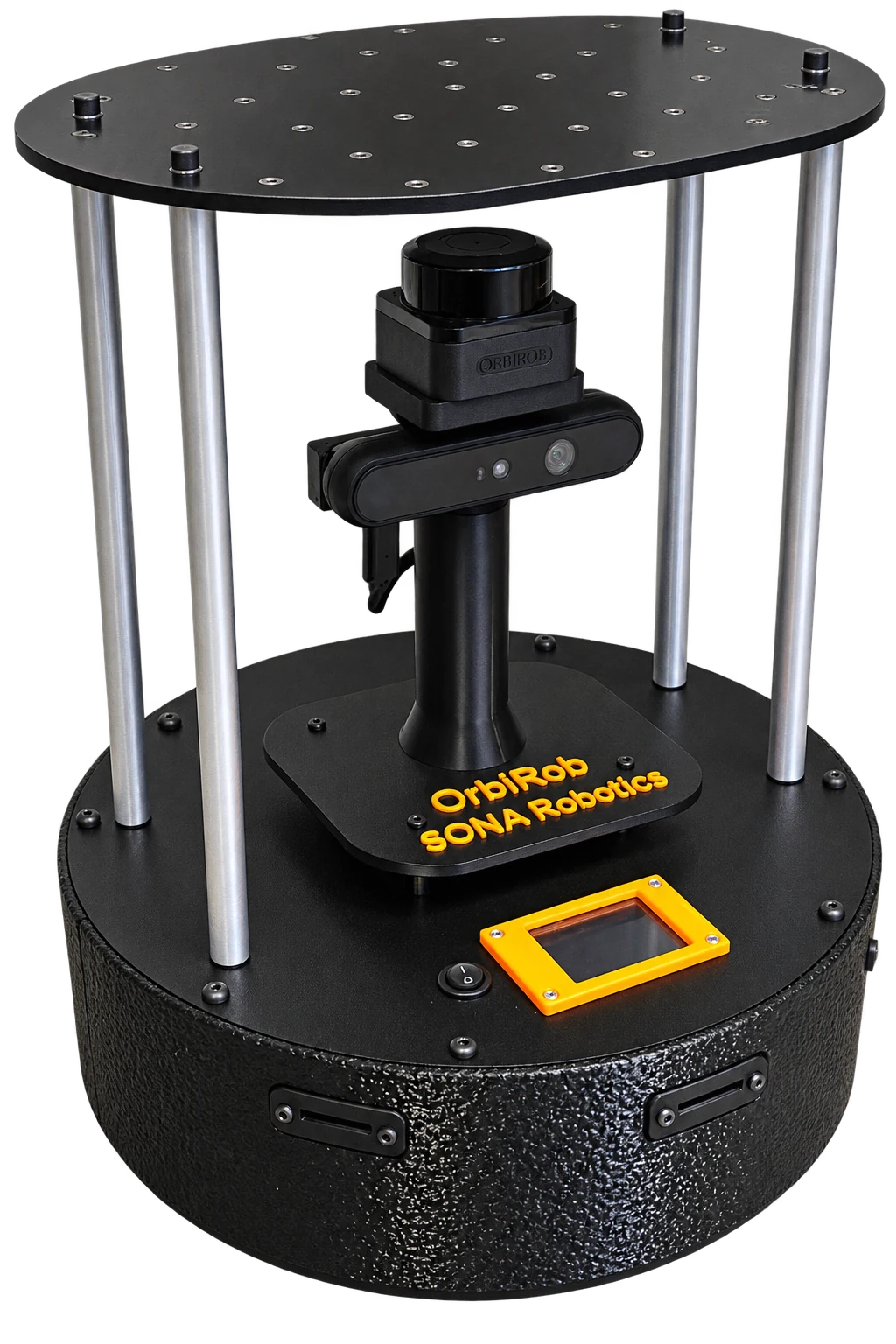
OrbiRob is built around standard ROS 2 concepts rather than a closed application layer. The same architecture supports classroom exercises, student projects and research code.
ROS 2 Jazzy
Core middleware
Ubuntu 24.04
Robot computer
C++ · Python
Application development
Nav2 · SLAM
Autonomy stack
ORBIROB · DEMOS
See perception and navigation capabilities operating on OrbiRob.
A demonstration of OrbiRob detecting people using its vision system.
OrbiRob navigates while avoiding obstacles.
Real-world autonomous navigation demonstration.
ARCHITECTURE
Motor, encoder and sensor interfaces provide deterministic hardware access.
Odometry, TF and robot model expose a standard ROS 2 representation.
LiDAR, camera and additional sensors enter through ROS 2 drivers and topics.
SLAM and localization components provide map and pose estimation.
Nav2 handles planning, control and autonomous goals.
Student and research nodes can be added in C++ or Python without changing the base platform.
DEVELOPMENT
ROS 2 packages can be studied, modified and rebuilt as part of a course or project.
The Gazebo model follows the same frames, interfaces and application-level expectations as the real robot.
Git-based development makes student work, examples and experiments easier to reproduce.
Use RViz, ros2 CLI tools, bag recording and the wider ROS ecosystem.
AUTONOMY
OrbiRob provides the standard building blocks needed to get a robot moving autonomously, while keeping every layer open to replacement. A research group can keep the hardware and swap in its own planner, localization system, perception stack or controller.
Tell us which ROS 2 topics, algorithms or sensors matter to your lab and we can walk through the architecture in a technical demo.